
Key Points
It is essential to monitor several KPIs simultaneously since humans are highly variable systems. This helps to understand what is actually driving the observed changes or to perform multivariate analysis to identify meaningful data patterns. The KPIs listed below are the most commonly used in the literature and show good correlations with key performance outcomes. However, this does not mean that other metrics cannot be relevant or meaningful.
Performance Assessment
|
Purpose
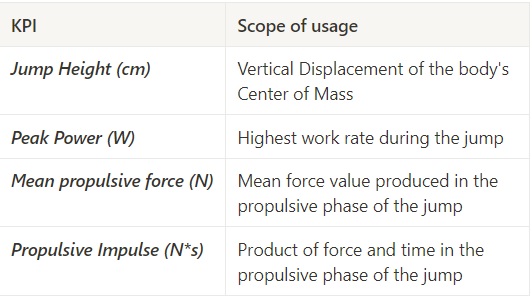
To test and assess correlations with other physical capacity measures. KPIs
The KPIs listed here are supported by literature as being correlated with performance in activities such as strength, linear acceleration, linear speed, and change-of-direction ability. |
 |
Neuromuscular Fatigue
|
Purpose
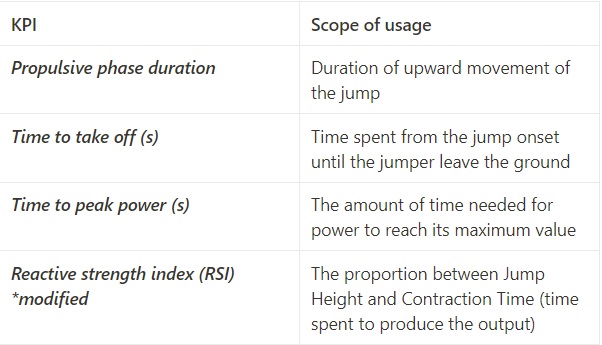
To detect neuromuscular fatigue. |
 |
Injury – Rehabilitation
|
Purpose
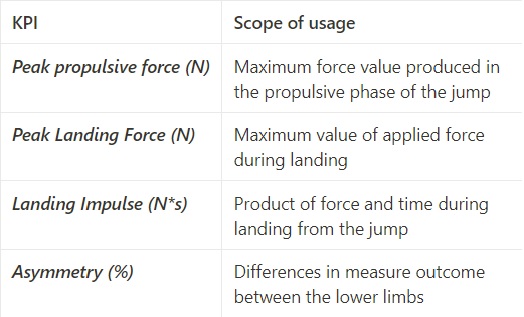
To assess progress after injury and support decision-making for return-to-play actions. |
 |
References
|
1. Alemdaroğlu U. The relationship between muscle strength, anaerobic performance, agility, sprint ability, and vertical jump performance in professional basketball players. J Hum Kinet 31: 149–158, 2012. |
2. Koklu Y, Alemdaroglu U, Ozkan A, Koz M, and Ersoz G. The relationship between sprint ability, agility, and vertical jump performance in young soccer players. Sci Sports 30: e1–e5, 2015. |
|
3. Bishop, Chris PhD1; Jordan, Matt PhD2; Torres-Ronda, Lorena PhD3; Loturco, Irineu PhD4; Harry, John PhD5; Virgile, Adam MS6; Mundy, Peter PhD7; Turner, Anthony PhD1; Comfort, Paul PhD8. Selecting Metrics That Matter. Strength and Conditioning Journal, 2023. |
4. Loturco I, D’Angelo R, Fernandes V, Gil S, Kobal R, Cal Abad C, Kitamura K, and Nakamura F. J Strength Cond Res 29: 758–764, 2015. McFarland I, Dawes J, Elder C, and Lockie R. MDPI Sports 4: 11–17, 2016. |