
Definition
Rate of Force Development (RFD) is a measure of how quickly an individual can generate force. It quantifies the rate at which force is produced during a specific time interval. RFD is commonly used in the context of athletic performance, as it reflects an individual’s explosive strength and power capabilities.
The units of RFD depend on the units used for force and time. For example, if force is measured in Newtons (N) and time in seconds (s), RFD is expressed in N/s.
Rate of Force Development: Deceleration RFD is calculated as the change in force divided by the change in time during the deceleration phase.
Deceleration RFD = ΔF / Δt
Where:
-
- ΔF = Change in force during deceleration.
- Δt = Time taken to decelerate.
Rate of Force Development (RFD) in Countermovement Jumps (CMJ)
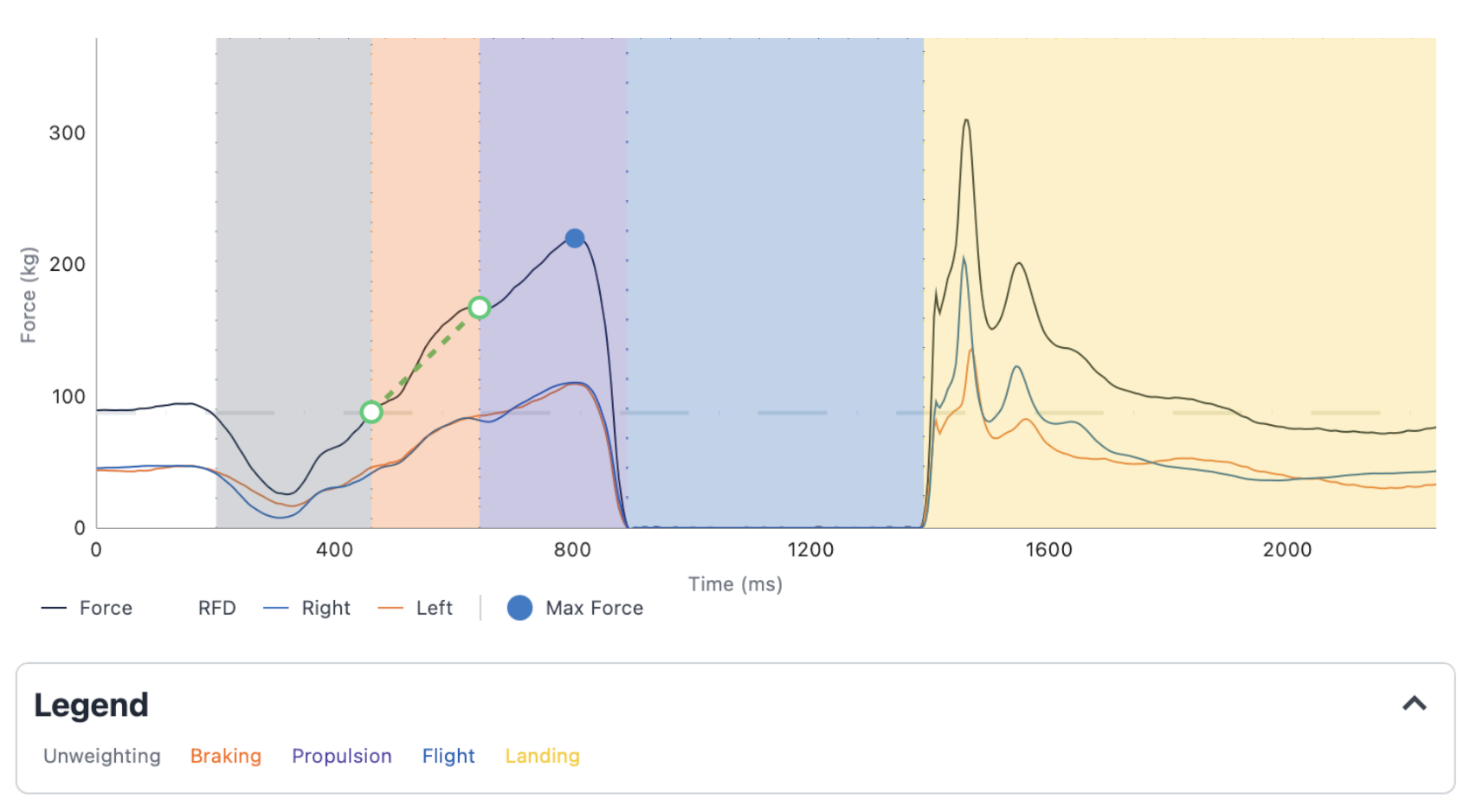
The deceleration Rate of Force Development (RFD) refers to the rate at which force increases during the braking phase of a movement. This phase begins at the moment of peak negative center of mass (COM) velocity and continues until COM velocity returns to zero. This point coincides with the bottom of the countermovement, representing the peak negative COM displacement (the deepest part of the jump).
In the context of the countermovement jump (CMJ), RFD during the braking phase indicates the speed at which force is applied. Practically, it measures how quickly an athlete can increase the applied force, making it a potential indicator of explosiveness. This explosiveness encompasses both neuromuscular and coordination characteristics in a multi-joint movement such as the CMJ. Notably, RFD is independent of an athlete’s mass, muscle size, or body dimensions and does not necessarily correlate with output power.
RFD can be used to detect the motor strategy employed by the neuromuscular system to optimize the function of the stretch–shortening cycle (SSC). If braking RFD is increased and the required time is minimized, a higher level of force can be generated, leading to improved vertical jump performance.
Additionally, RFD analysis can provide valuable insights into an athlete’s recovery, particularly in cases involving anterior cruciate ligament (ACL) injuries. Studies have shown that RFD in the quadriceps and hamstrings remains consistently depressed in ACL patients, recovering more slowly than maximal muscle strength. Active tissues—such as the quadriceps and hamstrings—are essential for absorbing external energy and protecting passive structures such as the ACL.
What High or Low Deceleration RFD Represents
High Deceleration RFD
Characteristics: Indicates a rapid reduction in force during the deceleration phase.
Implications:
-
- Explosiveness: Athletes with high deceleration RFD can quickly reverse momentum, which often correlates with higher overall jump heights.
- Neuromuscular Efficiency: Reflects strong and efficient eccentric muscle control.
- Elastic Energy Utilization: Suggests effective storage and transfer of elastic energy during the stretch–shortening cycle (SSC).
Use Cases:
-
- Favorable for sports requiring quick, explosive movements (e.g., change of direction, jumping, agility).
Low Deceleration RFD
Characteristics: Indicates a slower reduction in force during the deceleration phase.
Implications:
-
- Reduced Explosiveness: May correlate with lower jump performance or less efficient momentum reversal.
- Eccentric Weakness: Suggests weaker control during the eccentric phase, potentially leading to less energy storage in the SSC.
- Potential Risk: Could indicate a neuromuscular limitation or inefficiency, increasing injury risk—especially in movements requiring rapid deceleration.
Use Cases:
-
- Athletes with low deceleration RFD may benefit from targeted eccentric strength training and plyometric exercises to improve SSC function and overall performance.
Practical Applications
Performance Assessment:
-
- High deceleration RFD is often desirable in power athletes, as it signifies readiness to perform explosive tasks effectively.
- Low deceleration RFD may indicate areas for improvement in eccentric control or SSC utilization.
Injury Prevention:
-
- Monitoring deceleration RFD can help identify imbalances or weaknesses that increase the risk of injury during high-speed movements.
Training Focus:
-
- High RFD: Emphasize maintenance and fine-tuning through advanced plyometrics or velocity-specific training.
- Low RFD: Focus on eccentric strength training, isometric holds, and controlled plyometric drills to enhance SSC efficiency.
RFD in Isometric Tests Like Grip
Rate of Force Development (RFD) during a hand grip strength measurement can provide information on an individual’s ability to generate force quickly and explosively, which is important in sports that require grip strength and power. Research has shown that hand grip strength and RFD are related to performance in a variety of sports, including those that involve throwing, hitting, and lifting. For example, a study found that hand grip strength and RFD were positively correlated with throwing velocity in baseball players. Another study found that hand grip strength and RFD were positively correlated with muscle power and jumping ability in volleyball players. Additionally, a systematic review found that hand grip strength and RFD are related to performance across various sports and can be used as part of a comprehensive performance assessment program.
Research shows that RFD and the ability to maintain maximum grip strength are linked in stroke survivors. RFD is reduced in the affected hand early after stroke, and the difference between the affected and non-affected hand decreases markedly during the first year after stroke. Thus, grip RFD can serve as a biomarker for monitoring the recovery and functionality of stroke survivors.
References
|
|||
1Cormie P., McGuigan M.R., Newton R.U. (2010). Changes in the eccentric phase contribute to improved stretch–shortening cycle performance after training. Med Sci Sports Exerc. 42(9): 1731–1744. |
2Laffaye G., Bardy B., Durey A. (2007). Principal component structure and sport-specific differences in the running one-leg vertical jump. Int J Sports Med. 28(5): 420–425. |
3Wilson G., Lyttle A., Ostrowski K., Murphy A. (1995). Assessing dynamic performance: a comparison of rate of force development tests. J Strength Cond Res. 9: 176–181. |
4Baratta R., Solomonow M., Zhou E., Letson D., Chuinard R., D’Ambrosia R. (1988). Muscular coactivation: the role of the antagonist musculature in maintaining knee stability. Am J Sports Med. 16: 113–122. doi:10.1177/036354658801600205 |
5Jordan M.J., Morris N., Lane M., Barnert J., MacGregor K., Heard M., Robinson S., Herzog W. (2020). Monitoring the Return to Sport Transition After ACL Injury: An Alpine Ski Racing Case Study. Front Sports Act Living. 2: 12. |
6Stock R., Askim T., Thrane G., Anke A., Mork P.J. (2018). Grip strength after stroke: Rate of force development and sustained maximal grip strength. Ann Phys Rehabil Med. 61: e352–e353. |
7Banyard H.G., Sands W.A. (2016). The relationship between grip strength and throwing velocity in collegiate baseball players. J Strength Cond Res. 30(12): 3469–3475. |
8Gribble P.A., Hertel J. (2018). The relationship between grip strength and jumping ability in female volleyball players. J Strength Cond Res. 32(7): 2021–2028. |
9Gribble P.A., Hertel J. (2019). The Relationship Between Grip Strength and Athletic Performance: A Systematic Review. J Strength Cond Res. 33(6): 1681–1694. |
|||