Impulse Definition and Calculation
When a force is applied to a body, the resulting motion depends not only on the magnitude of the applied force but also on the duration of the force application. The product of force and time (t) is known as impulse:
Impulse = Force × Δt
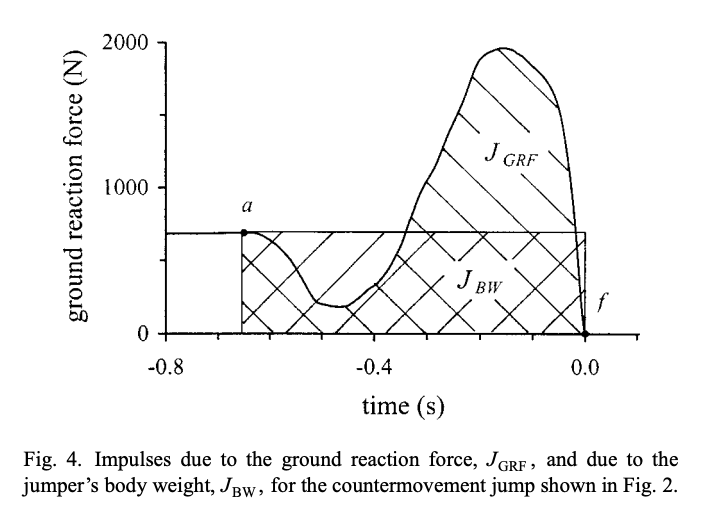
When a vertical jump is performed on a force platform, a graphical display of the vertical Ground Reaction Force (GRF) across time can be generated. Since impulse is the product of force and time, the impulse is the area under the force–time curve. The larger the impulse generated against the floor, the greater the change in the performer’s momentum, resulting in a higher jump.
Theoretically, impulse can be increased by raising either the magnitude of the applied force or the duration over which it acts. However, in practice, if the force application time is prolonged during a vertical jump, the magnitude of force that can be produced is significantly reduced, leading to a smaller impulse. To achieve a maximal vertical jump, the performer must maximize impulse by finding the optimal balance between force magnitude and force duration.