
In this article, you will find the correct ways to perform each jump to achieve an optimal result and, on the other hand, all scenarios of incorrect executions that return zero results.
We will look at CMJ, Drop Jump, and Squat Jump.
– CMJ –
Countermovement jump execution
Your patient should follow these instructions to execute a CMJ (Countermovement Jump):
- Start by standing with feet shoulder-width apart and toes pointing slightly outward.
- At the end of the countdown, bend the knees and lower into a squat while keeping the back straight and chest up. This is the countermovement phase.
- Quickly reverse the movement and explode upward, extending the hips, knees, and ankles simultaneously.
- Aim to achieve maximum height.
- Land softly by flexing the hips, knees, and ankles to absorb the impact.
- After landing from the jump, remain on the platform until the end of the assessment.
Proper CMJ signal
If your CMJ signal doesn’t look like this, it’s probably due to an incorrect execution.
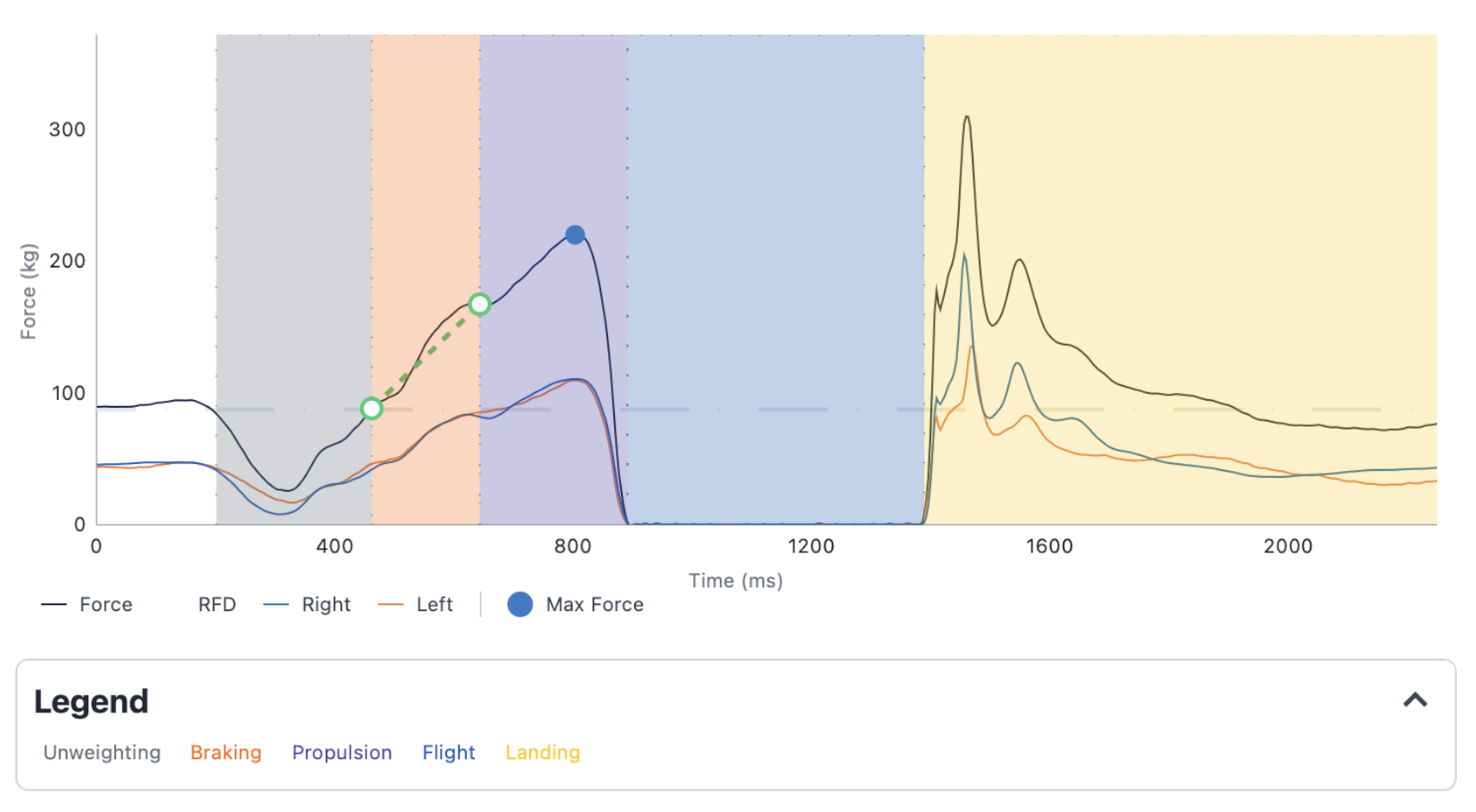
Fail cases
Jump too early
When a person jumps too early, the movement starts before the end of the countdown. This leads to an incomplete ground reaction force (GRF) plot. As a result, the plot may not accurately capture the complete force profile needed for analysis.
Movement during the weighting phase
Excessive movement during the weighting phase (before the jump, during the countdown) can affect the accuracy of the GRF plot.
Excessive shifting, swaying, or lateral movement can lead to inconsistent ground contact and force distribution. As a result, the GRF plot may show irregular patterns or fluctuations that do not reflect expected force production.
To address this, focus on maintaining stability and minimizing movement during the weighting phase. Encourage proper body control and alignment, emphasizing a stable, centered position before initiating the jump.
No countermovement
The GRF plot can appear incorrect because no countermovement or unweighting phase was detected.
The countermovement is the initial downward phase where the muscles are pre-stretched before moving upward. This is crucial for optimizing force production and jump height.
If no countermovement is detected, it suggests the person did not descend properly before initiating the upward jump. As a result, the GRF plot may not capture the expected force profile.
💡 If you don’t want your patient to perform a downward phase before the jump, use a Squat Jump. You can check the Squat Jump section below to choose the appropriate jump.
To improve the accuracy of the GRF plot, ensure the countermovement and unweighting phase are executed properly. Here are some tips:
- Perform a clear downward movement before the jump to pre-stretch the muscles.
- Aim for a brief unweighting phase at the bottom of the countermovement.
- Emphasize timing and technique so the countermovement and unweighting phase optimize force production.
– Drop Jump –
Drop jump execution
Your patient should follow these instructions to perform a Drop Jump:
- Step onto an elevated surface (box or step). Height depends on experience and capability.
- Step off and land immediately after the countdown. Land softly (hips, knees, ankles flexed) with proper mechanics.
- Upon landing, immediately explode upward by extending hips, knees, and ankles (reactive jump).
- Aim for maximum height with an explosive, quick movement.
- After landing from the jump, remain on the platform until the end of the assessment.
Proper DJ signal
If your DJ signal doesn’t look like this, it’s probably due to an incorrect execution.
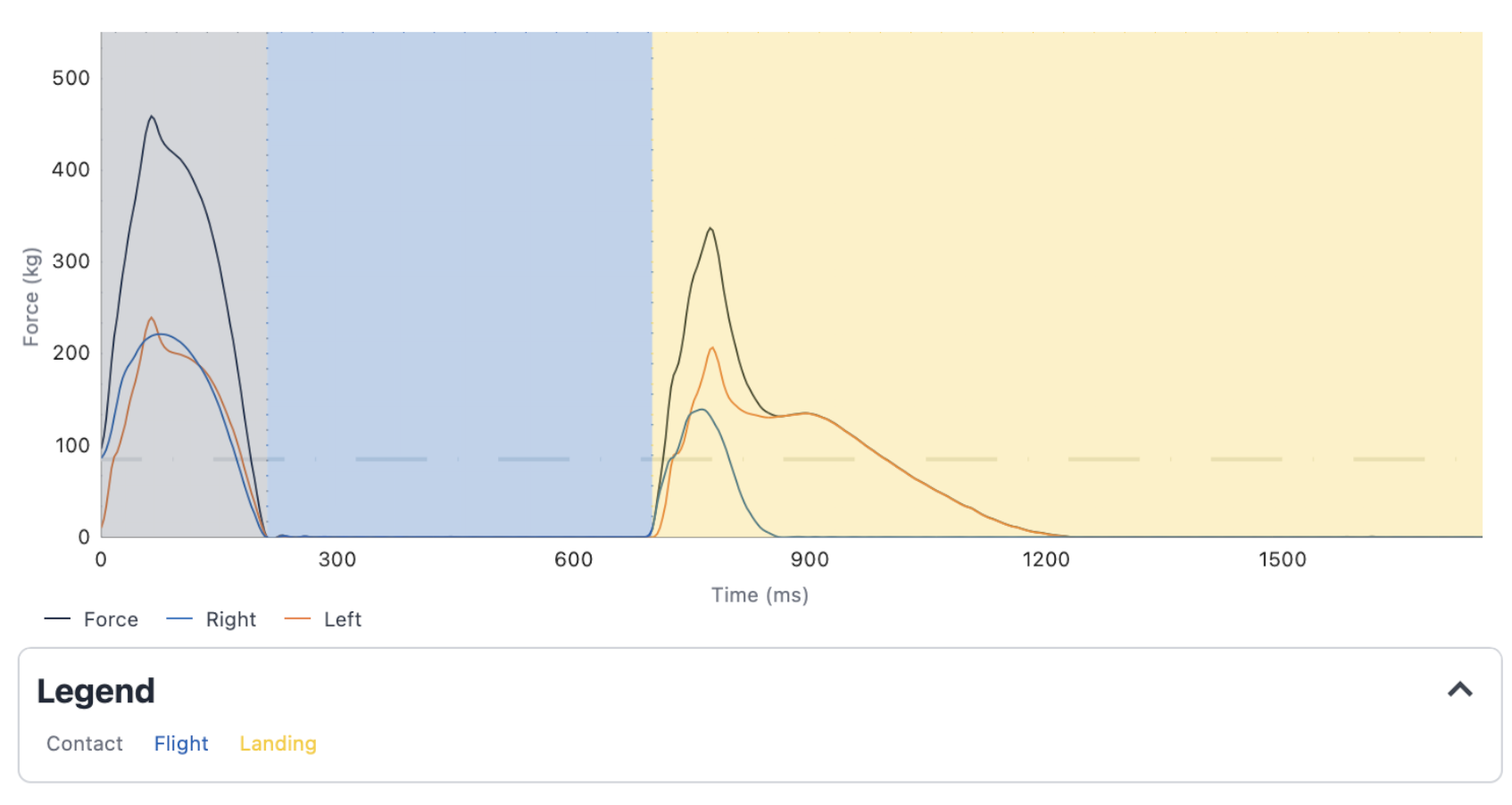
Fail cases
No jump after landing
The GRF plot appears incorrect because the patient did not jump after landing.
In a drop jump, the primary goal is to land and immediately perform an explosive jump. If the upward phase does not follow the landing, the GRF plot will not capture the expected reactive profile.
💡 If you don’t want the patient to jump after landing, use a landing assessment instead (search for “Bipodal Landing” or “Single Leg Landing” based on your goal).
– Squat Jump –
Squat jump execution
Your patient should follow these instructions to perform a Squat Jump:
- Start standing with feet shoulder-width apart and toes slightly outward.
- Bend the knees and lower into a squat, keeping the back straight and chest up.
- Lower the hips until the thighs are parallel to the ground (or as mobility allows).
- When the countdown finishes, explode upward without any downward movement, extending hips, knees, and ankles simultaneously.
- Jump as high as possible while maintaining control and good form.
- After landing, remain on the platform until the end of the assessment.
Proper SJ signal
If your SJ signal doesn’t look like this, it’s probably due to an incorrect execution.
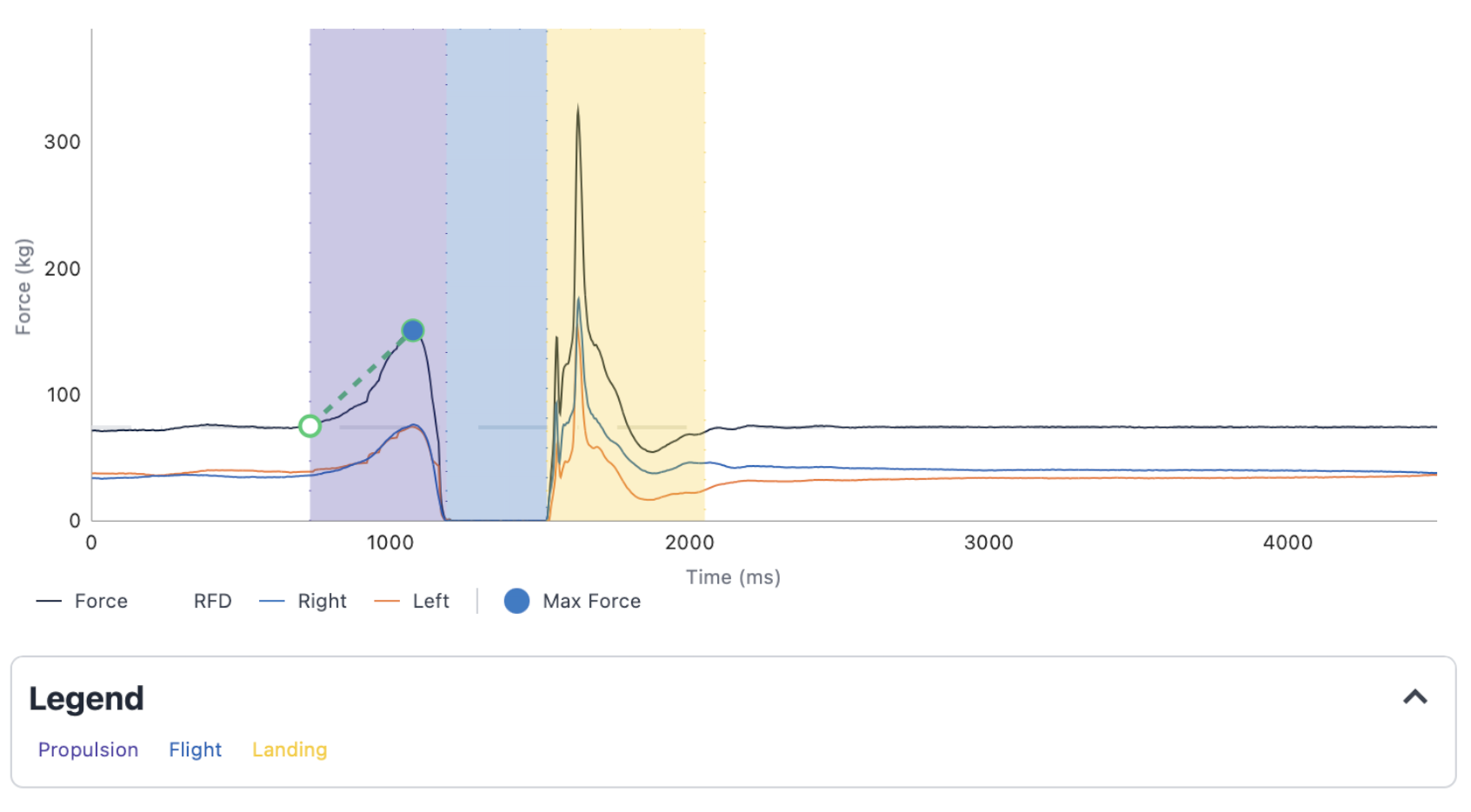
Fail cases
Jump too early
Starting the jump before the end of the countdown leads to an incomplete GRF plot and an unreliable force profile for analysis.
Movement during the weighting phase
Excessive movement during the weighting phase can affect the accuracy of the GRF plot.
Swaying or shifting can cause inconsistent ground contact and force distribution, leading to irregular or unexpected force patterns in the GRF plot.
Encourage stability and a centered stance during the countdown to improve signal quality.
Countermovement detected
The SJ GRF plot appears incorrect because a countermovement was performed.
In a Squat Jump, the patient should start from a static squat and then explode upward without a prior downward movement.
💡 If you want a downward phase before the jump, use a Countermovement Jump (CMJ) instead.