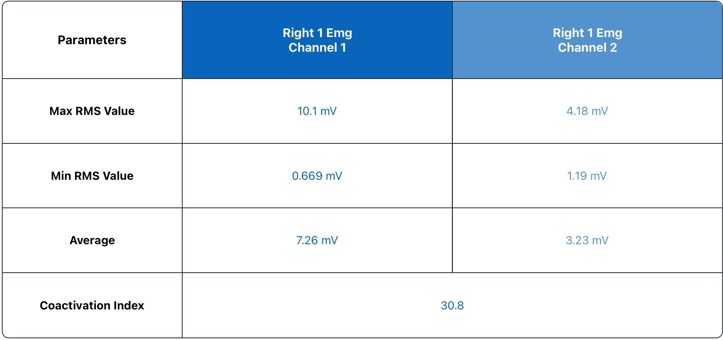
The Metrics
Electromyography (EMG) is a valuable technique for studying the electrical activity of muscles during various actions and movements. To analyze these EMG signals, several parameters are used, including Peak RMS (Root Mean Square), Average RMS (Root Mean Square), and the Co-activation Index. Each of these parameters offers unique insights into muscle activity and coordination between muscles during specific tasks. In this guide, we explore these EMG measures in detail and their role in assessing muscle activity and coordination.
1) Peak RMS (Root Mean Square)
- Peak RMS, also known as "maximum RMS value", represents the maximum amplitude of the EMG signal over a specific period. It is particularly useful for identifying peaks in muscle activity during intense contractions.
2) Average RMS (Root Mean Square)
- Average RMS, also known as "mean RMS value", measures the average amplitude of EMG signals recorded over a given period.
– It is often used to assess overall muscle activity during a task or period, providing an indication of the average intensity of muscle activation.
3) Co-activation Index
- ⚠️ The co-activation index only appears when the 2nd channel is selected and placed on an antagonist muscle.
– It measures the relative coordination between two antagonistic muscles (muscles with opposing actions) recorded using EMG.
– It is calculated by comparing the electrical activity of agonist muscles (performing an action) and antagonist muscles (opposing the action) during a task or movement.
– A high co-activation index may indicate poor muscle coordination or overuse of antagonist muscles.